September 25, 2009
I was out to inspect the spread footings today in the Preserve at Pine Meadows and everything looked great. The contractor, Bud Moore with American Craftsman Homes met me out there and we went over the schedule for the reamining concrete pours.
He was very complimentary about how the home nestled into the site and also how we nailed the views from the home’s footprint.
This is the second project that we designed in The Preserve that American Craftsman Homes has built and the third design in the development. We look forward to many more in this great mountain community.

Leave a Comment » |
Construction, House, Projects in Process, Residential |
Permalink
Posted by Dean Dalvit
August 26, 2009
As it turns out, getting a .info suffix routed to a new host can take 48 hours. So the move to the new host may still be a day or two out.
In the meantime, there are no shortage of archives, hundreds of stories to read.
Leave a Comment » |
Uncategorized |
Permalink
Posted by evstudio
August 22, 2009

Jim and I went by Pink Fog to inspect the steel connections on the stair to the loft.
Due to existing conditions, we designed a stair that would avoid placing a post in front of a window. The design required both cantilevered upper floor framing and a cantilevered stringer. In order to make this work, we utilized a unique structural design with a bent frame to handle the torsional force and the cantilevers.
Leave a Comment » |
Building Technology, Construction, Denver, Projects in Process | Tagged: Denver, Loft, stair, Steel |
Permalink
Posted by Sean O'Hara
August 21, 2009

On August 18, the removal of the 2″ concrete flanges of the concrete double T wall began. EVstudio engineered the front wall to allow for the new openings and provided details to adequately brace the structure with the remaining wall lengths. When construction is completed you won’t be able to tell this was once a double T wall building with the typical visible flanges.
Leave a Comment » |
Commercial, Construction, Engineering, Evergreen, Remodels, Retail | Tagged: Commercial, Construction, Design, Double T, Retail, Structure |
Permalink
Posted by Jim Houlette
August 20, 2009

The Prairie Style is often associated with Frank Lloyd Wright and the Arts and Crafts Movement of the early 1900s. One of his finest examples was the Robie House with its dramatic overhangs, stretches of art glass windows, open floor plan, and sweeping horizontal lines that echoed the prairies of the great Mid-West. The Prairie style is seen as Wright’s reaction to the overly-ornate Victorian style of the late 19th century. Although it was designed nearly a century ago, the Robie House remains a prime example of modern residential architecture.
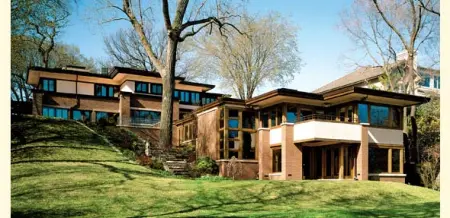
Today’s Prairie Style homes include many of the same attributes: shallow-pitched hip roofs, oversized eaves, cantilevered projections, open interior spaces, central chimney massing, minimal exterior ornamentation, and low proportions. Different geometric shapes are often highlighted through window arrangement, columns, low walls and planters, all which create an aesthetically appealing home. Transitions between indoor and outdoor spaces are seamless with broad covered porches and large masonry columns. Large casements as well as rows of clerestory windows are commonly seen in Prairie style homes to provide plenty of daylight for a comfortable interior and also to accentuate its linearity. Massing generally consists of boxed shapes at varying heights and depths. Layouts tend to include open common areas with no hallways on the main level, and a modular grid floor plan using only right angles.

Brick is the most common exterior material used in Prairie Style design, but today many of these homes combine it with other materials such as stucco, stone, or concrete block. The materials were generally light-colored to blend in with the home’s natural surroundings.
Leave a Comment » |
Architect, Architectural process, House, Modern, Residential | Tagged: Architectural Styles, Architecture, Home, House, Modern, Residential, window |
Permalink
Posted by Beth Concha
August 20, 2009
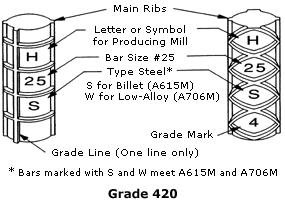
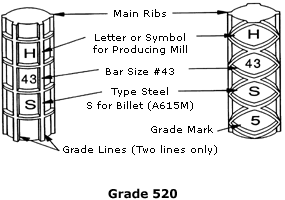
In order to identify the basic information about the rebar that is delivered to a jobsite, it is important to know how to read the mill markings that are stamped on every bar. This is especially critical to ensuring that your materials match up with the specifications in the plans.
These mill markings illustrate the “soft metric” system adopted by CRSI member mills in 1997 (see our post about metric and imperial markings):

Images and bar marking description courtesy of CRSI
The top letter or symbol identifies the producing mill and deformation pattern.
The next marking is the bar size.
The third marking symbol designates the manufacturing material — usually either “S” for carbon-steel (ASTM A615) or “W” for low-alloy steel (ASTM A706).
Finally, there will be a grade marking (4 or 5, for 420 or 520) or by the addition of one line (420) or two lines (520) that must be at least five deformations long.
For more information, please visit www.crsi.org/rebar
Leave a Comment » |
Construction, Engineering | Tagged: Construction, Engineering, Structure |
Permalink
Posted by Dean Dalvit